
Yolo County Arrest Log Sources
No single blotter covers every agency in the county. The Sheriff’s Crime Data and Booking Status page lays out the two county-level options. One is physical. Press-board copies of the past week’s Sheriff arrest reports sit in the Monroe Detention Center lobby. The other is remote: monthly booking-statistics PDFs linked from the Sheriff’s site. Each answers a different question about Yolo County arrests. Neither behaves like a live feed.
The lobby board gives a current official view. But it works only in person and only for the week YCSO describes. The monthly archive reaches further back. It groups selected Sheriff arrest entries by month. Yet it is not a full count of every arrest in Yolo County. YCSO states this plainly. Statutory restrictions and sensitive confidential investigations keep some incidents out of public reports.
Need today’s answer instead of history? Use the 24 Hour Arrests route and call Monroe Records directly. A Yolo County arrest log entry is a record of an event, not a status. Someone named in it may already be out. Another may have been transferred elsewhere.
Read the Yolo County Blotter
Pick your source by agency and date. City entries often appear first. A Sheriff monthly record can lag well behind the arrest itself. Neither log carries the court outcome, so the Yolo County arrest log trail ends where the courthouse files begin.
- Identify the likely agency. Distinguish YCSO from Davis, Woodland, West Sacramento, UC Davis Police, CHP, or another department.
- Use the recent Sheriff window. For reports from the past week, view the press board at the Monroe Detention Center lobby.
- Search by month. Open the official booking-statistics hyperlinks and select the month that contains the arrest date.
- Check the proper city log. Davis uses Citizen RIMS; Woodland has a dedicated arrest-log search; West Sacramento routes requests through city records.
- Read each field narrowly. A location is not necessarily a home, and a charge is not a conviction.
- Follow the case. The Yolo Superior Court record is the source for public charging events and disposition.
Open the official YCSO monthly booking-statistics index represented in this capture.
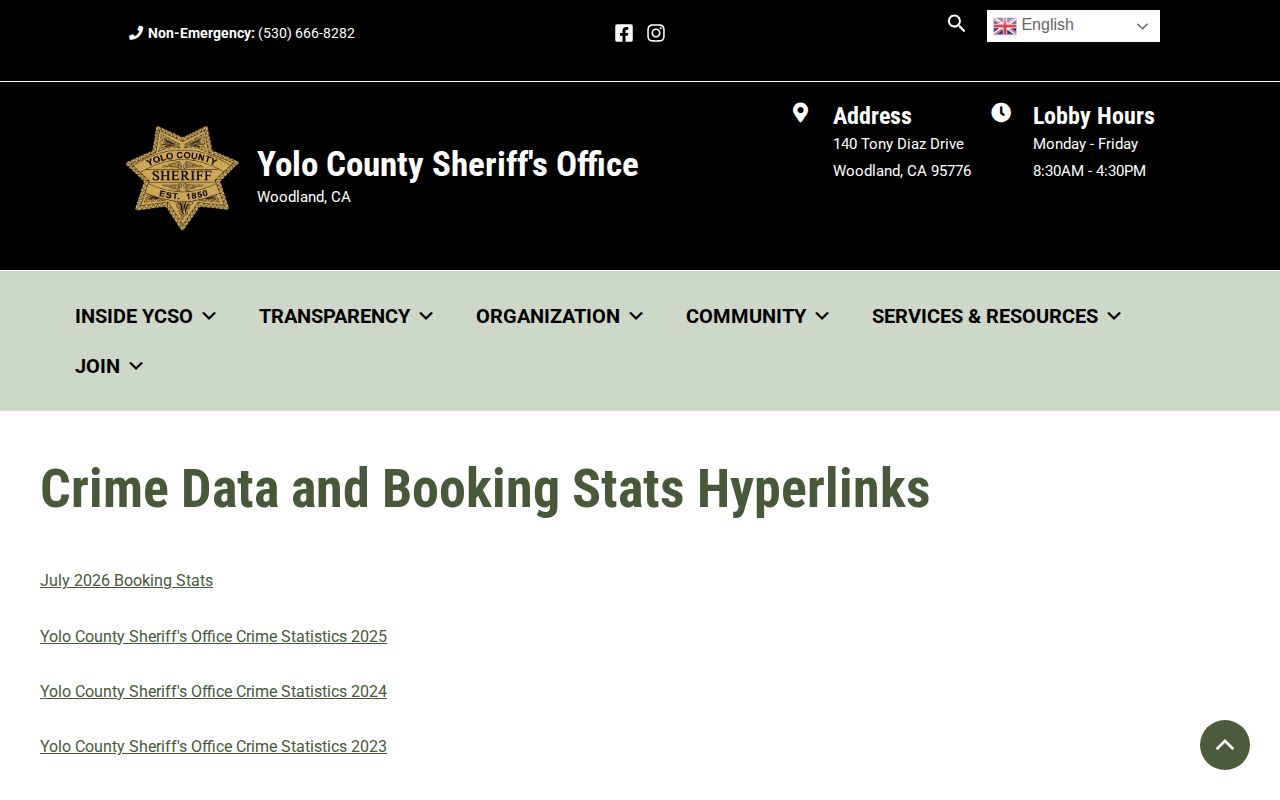
The index supplies month-based Sheriff reports rather than a rolling countywide custody roster.
Yolo Arrest-Log Entry Fields
The July 2026 YCSO PDF shows the online format in practice. Its title frames it as a press board for arrests made by the Yolo County Sheriff’s Office that month. The columns are narrow. Facts a commercial roster would list are simply absent.
| Published field | Careful reading |
|---|---|
| Name | Recorded last, first, and middle name or initial when present; a shared name is not enough to confirm identity. |
| Date | The arrest date, not the PDF posting date, booking time, or later court filing date. |
| Location of arrest | The reported arrest location; it does not prove residence or where alleged conduct occurred. |
| Charges | Charges recorded in the Sheriff report, subject to prosecutorial and court changes. |
| Not displayed | No booking number, intake time, jail facility, bail, housing, release, case disposition, or photograph column. |
A name sitting in a monthly PDF is not proof the person is still in jail. The reverse holds too. Someone missing from the Sheriff PDF may have been arrested by another agency, cited and released, or shielded by a publication restriction or a sensitive investigation. For present custody in Yolo County, call Monroe Records. For filed case details, go to the court.
Note: The report covers Sheriff arrests in its stated month, not every arrest by every agency across Yolo County.
Three Yolo Municipal Log Models
The three city sources work differently. The Davis Police Daily Activity Log posts Citizen RIMS bulletins that mix arrests in with other police activity. Davis notes that limited information protects victim privacy. Juvenile offenders and sensitive crimes stay out. That bulletin tracks city police work, not county custody, so a Davis arrest tells you nothing about who sits in Monroe now.
The Woodland Arrest Log takes a different shape. It is a dedicated search with start-date and end-date fields, query controls, and pagination. Woodland keeps a separate case log as well. A city arrest may lead to booking at Monroe later, but the city entry and the county custody record remain two distinct stages.
See Woodland’s official case-log interface in this capture.
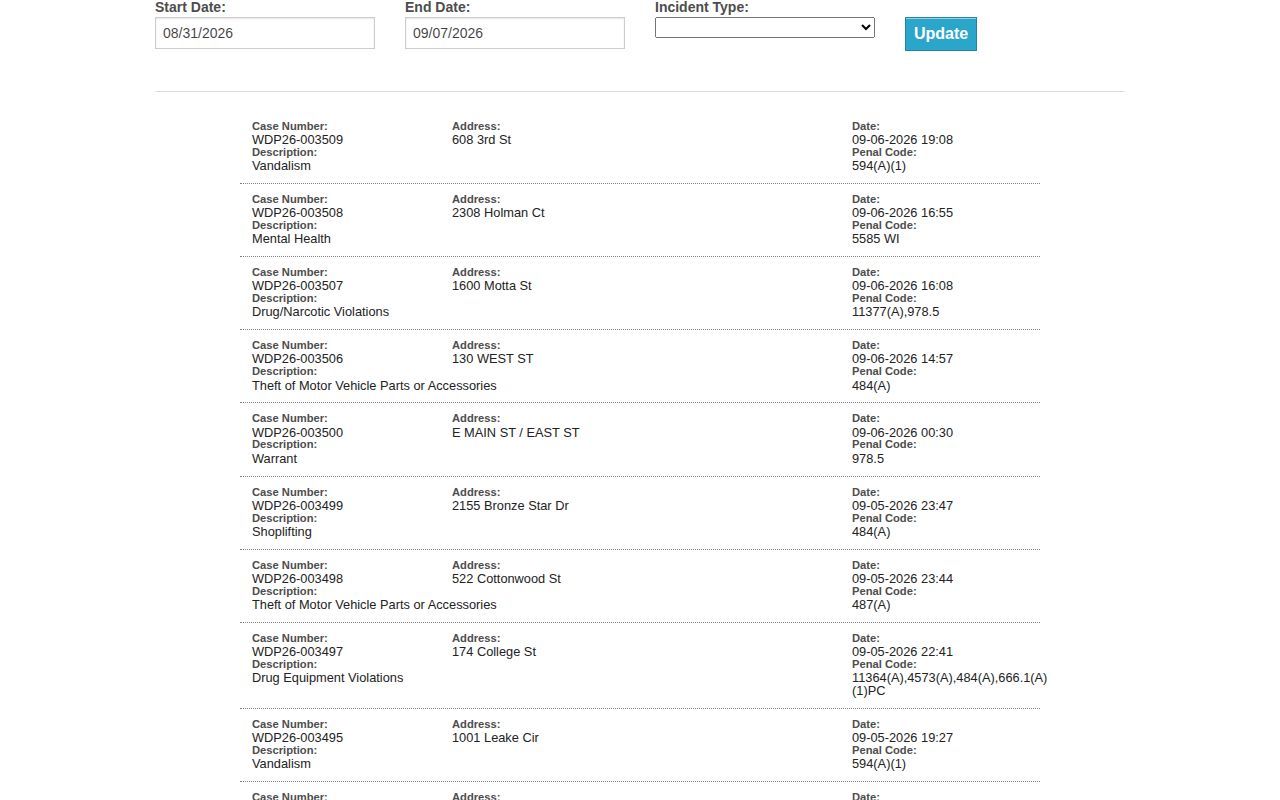
That interface is a reminder: search a city police log by agency and date. Never treat it as a Yolo County jail roster.
West Sacramento fits neither mold. The WSPD publishes no self-service arrest roster or log. Its Records Section and the city public-records portal are the official route to arrest logs there. City crime mapping is not a workaround either. Mapped incidents do not confirm a named arrest, a booking, a release, or a court result.
Yolo Arrest News Patterns
Local newspapers add narrative once the official Yolo County sources are exhausted. They are selective summaries, though, not government logs. The Daily Democrat runs local crime and court coverage. Its police-report items are brief. Each entry typically lists location, date, agency, the reported event, arrest status, and whether the person went to jail or got a citation. No booking-photo gallery comes with it.
The West Sacramento News-Ledger carries recurring "Arrest Reports" and "Incident/Crime Reports" drawn from police material. Items include names, dates, location, agency, the reported reason for the arrest, and whether the person landed in Yolo County Jail or received a citation. Older notices from the outlet say the items can rest on dispatch notes and initial reports. The Davis Enterprise also covers Davis crime and arrests. It lists no dedicated blotter page or photo policy.
View the Daily Democrat police-report format captured here.
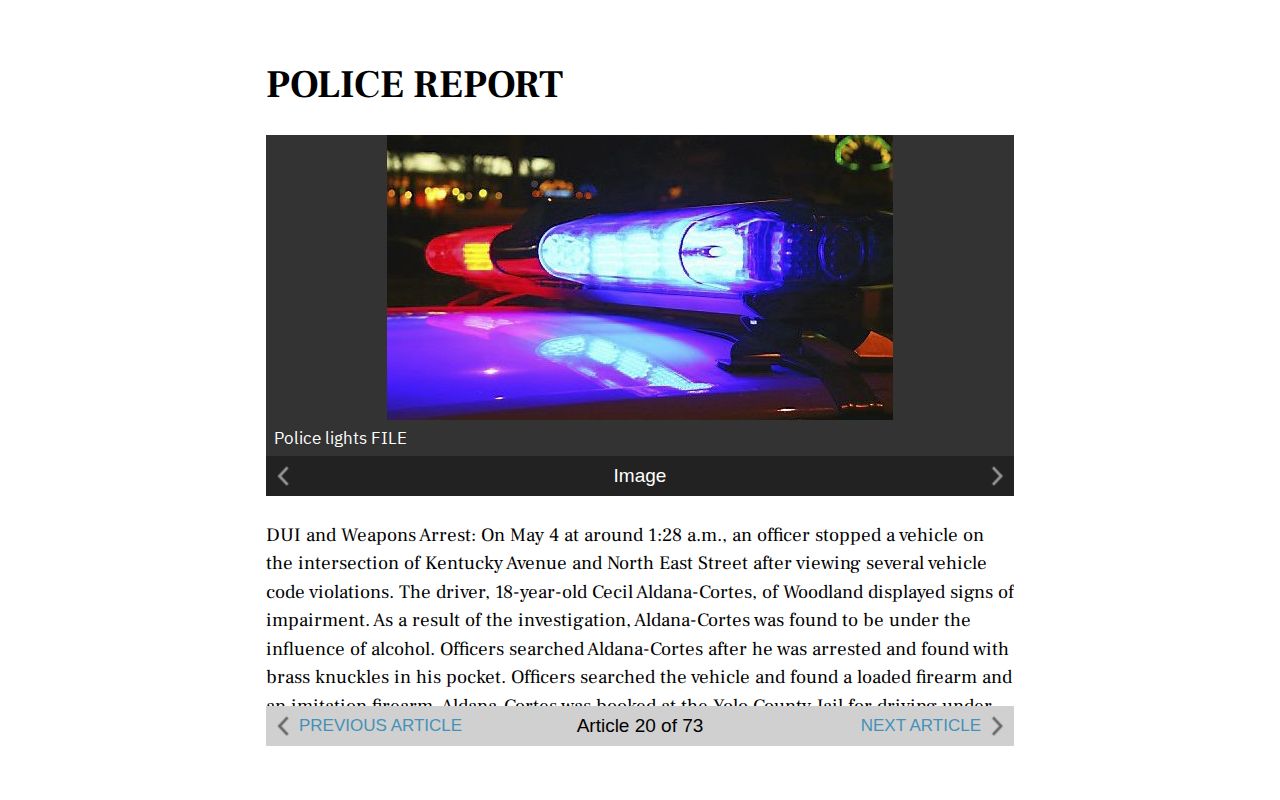
News coverage of Yolo County arrests adds color, but it is no stand-in for the booking record itself. Reporters get details wrong. Only the agency can confirm who is in custody. Treat a story as a lead, not the last word.
The Yolo County District Attorney newsroom plays a different part in the process. A charging release may name an arraignment date or a next hearing tied to a Yolo County arrest. That is useful when you are tracing a case through the courts. It will not tell you where someone is housed in the jail today.
Yolo Crime Data Is Different
Arrest logs, booking counts, mapped crime layers, and court dockets each track something different in Yolo County. The Sheriff's monthly PDFs cover specified YCSO arrests and nothing else. A city activity log is broader. It can list calls and incidents that never lead to an arrest. Those numbers should not be stacked against booking totals. West Sacramento's GIS crime service maps police data. But it carries no names and works nothing like a booking ledger. Court filings sit at the far end of the chain. They begin only when prosecutors bring a case. These gaps are why trend claims deserve caution. A jump in published entries might mean heavier enforcement. It might also reflect a change in reporting habits or a slow release schedule rather than more crime. A missing week could stem from system access or lawful withholding. Compare like periods from the same agency for trends. Pull the actual arrest, custody, or court record when the question is about a person.
- Arrest log
- An agency account of reported arrests within its scope.
- Incident map
- Location-based police data that may include events without an arrest.
- Booking record
- Jail intake documentation after a person enters custody.
- Disposition
- The final or later court outcome, which the blotter does not establish.
Yolo Arrest Archives and Retention
No fixed retention period exists. YCSO publishes none for its press-board reports, monthly PDFs, booking records, or photographs. The online archive simply stops where links stop. A pulled link does not mean the record itself was destroyed. Retention and public posting are two separate decisions. Older Yolo County arrest material may sit past the visible window. Send a focused request through the YCSO California Public Records Act page. Name the person. Give an approximate arrest date, and include the agency plus any location or report number. State the exact record you want. The records custodian can also tell you whether another agency holds it. Expect redactions or full withholding when a record is sealed, juvenile, victim-protected, or investigative.
Historical research runs on a different track. The California State Archives describes old sheriff record series. Examples include jail registers, monthly reports, criminal indexes, and some mug files. That inventory does not guarantee a modern Yolo booking photo survives there. The Yolo County Library Archives and Historical Collection may hold newspapers and local historical material. Neither archive answers current-custody questions. Note: Exact Yolo County booking retention rules come from the responsible records custodian, not a generic statewide claim or an old search snippet.
Yolo Arrest Reports Need Context
Context still matters when you read a Yolo County arrest report. Shared names trip people up. A misspelled entry can too. Verify identity through official records and compare dates and agencies before drawing conclusions. A booking photo, a news summary, or a dead archive link tells you none of that on its own. Some information stays withheld for lawful reasons. Sensitive and juvenile material is often kept back. When the details matter, go to the record itself.